


Compliance and Security: The “Security by Design” Approach
In the era of the Personal Data Protection Law (PDPL), security is not an afterthought; it is the foundation. CMT Technologies builds its Campus IPTV systems in Saudi Arabia with a “Security by Design” philosophy. This ensures that:
- Student Data Remains Private: All personal information and usage data are handled with strict PDPL compliance, specifically with a focus on data residency and localized processing.
- Academic IP is Protected: All educational content is secured via Digital Rights Management (DRM) to protect the university’s intellectual property.
- Emergency Alert Overrides: The system allows administrative or security teams to broadcast instant, campus-wide video alerts or safety instructions to every screen simultaneously, overriding all other content.
Lecture Capture and Recording, Plus On-Demand Revision
When teams search for a university IPTV solution Jeddah, they want more than live TV. They want a system that records lectures, so students can watch them again at any time. A lecturer teaches once in a hall. The system records the lesson, with slides and sound. Students can then revise at their own pace, in a library or in a student room. This helps students who miss a class. Recorded lessons can be sorted by course, subject and date. Teachers can also share short revision clips before exams. This approach fits the goals of Smart Education Solutions, which bring learning, video and campus services together. Access stays simple, and the content stays inside the university system.
Campus Use Cases: Where a University IPTV System Works Every Day
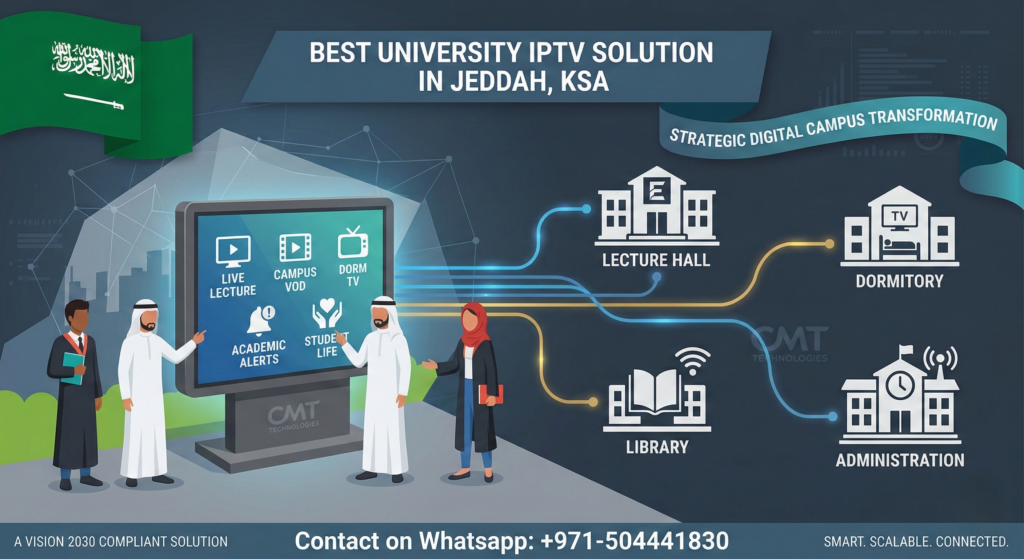
Campus IPTV touches many parts of university life. In student housing, each room TV can show live channels, recorded lectures and campus news. Faculty and department channels can share news, research updates and event dates for each college. Prayer times and exam timetables can appear on screens in halls and corridors, so students always see the latest times. Graduation and event live streaming can reach families and students who cannot attend in person. Digital signage and wayfinding can guide visitors to halls, offices and exam rooms. Emergency alerts can reach every screen at once, with clear steps to follow. Multilingual content can help international students, with channels and notices in more than one language. These use cases show why IPTV solutions for education help large universities, and schools use the same idea at a smaller scale, so this is also a clear model for IPTV for schools.
Jeddah Universities: A Growing Market for Campus IPTV
Jeddah is a large education hub on the west coast of Saudi Arabia. The city is home to the University of Jeddah, which has more than 25,000 students, 8 campuses and 17 faculties. It is also home to King Abdulaziz University, one of the largest universities in the Kingdom, and to a number of private colleges. These are market facts, not a client list. A large campus needs one clear way to share video, notices and live events, and a university IPTV solution in Jeddah fits this need. Interest in IPTV in Saudi Arabia and the wider IPTV Middle East market is strong, and the best IPTV provider in the Middle East is the one that can deploy, train and support at campus scale. CMT Technologies shared an earlier guide to a university IPTV solution in Riyadh, and this Jeddah guide builds on the same idea.
System Architecture for a Campus
A good campus design starts with the network. The system runs on the university campus network, with VLANs that keep IPTV traffic apart from other traffic. Multicast sends one live stream to many screens at once, so the network stays fast even at peak times. The design works across more than one campus, with a central headend and local screens in each building. This design is a proven IPTV system for university campuses in the region. Smart TVs can run the IPTV app with no extra box, while set-top boxes suit older screens and shared rooms. Mobile and BYOD viewing lets students watch on phones, tablets and laptops, with secure sign-in. The system can also link with Moodle and Blackboard, so recorded lectures sit next to course notes and tasks. For viewing outside the campus network, the same content can reach phones and laptops through OTT services. The result is one system for halls, libraries, housing and mobile screens.
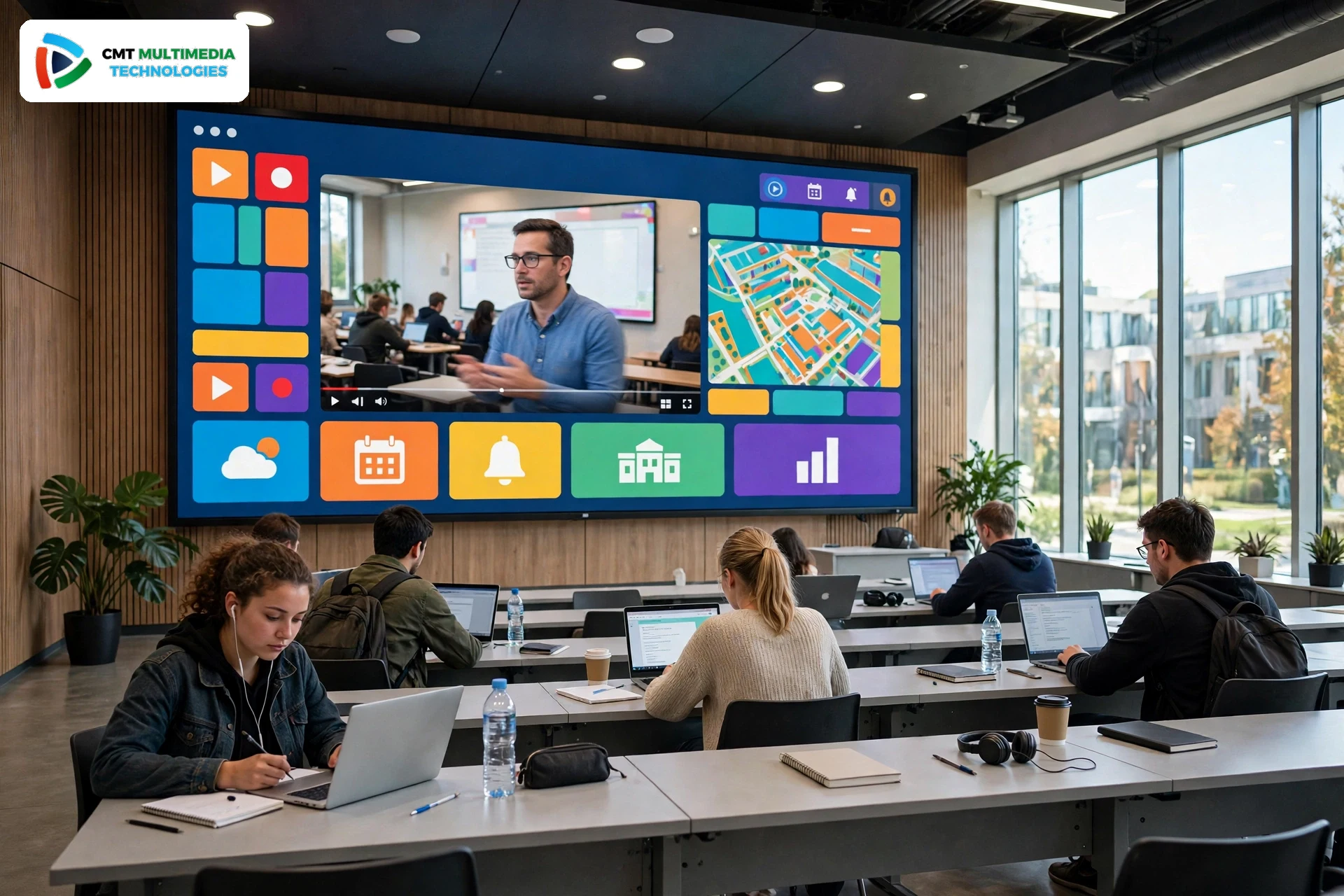
IPTV in a university lecture hall in the Middle East
IPTV vs SMATV vs Streaming Apps for a Campus
SMATV uses satellite dishes and coax cables to send TV to screens. It works, but it is hard to change, hard to grow and hard to link with learning tools. Streaming apps give each user a separate service, with no campus control, no shared notices and no emergency alerts. IPTV for universities is different. It uses the campus network, it is managed from one place, and it mixes live TV, recorded lectures, notices and alerts on the same screens. For a campus, that control matters. IT teams can add a channel, change a notice or send an alert in minutes, without new cables in every room. That is why many universities now choose education IPTV over SMATV and single streaming apps.
| Feature | IPTV | SMATV | Streaming Apps |
|---|---|---|---|
| Network | Campus network (LAN and Wi-Fi) | Satellite dish and coax cables | Public internet, per user |
| Control | One central control for all screens | Fixed channels, hard to change | No campus control |
| Live TV | Yes, live channels on every screen | Yes, live TV only | Yes, per app and per user |
| Recorded lectures | Yes, with on-demand revision | No | No, separate from courses |
| Campus notices and alerts | Yes, on all screens at once | No | No |
| LMS link | Yes, Moodle and Blackboard | No | No |
| Growth and change | Easy to grow and change | Hard to grow, needs new cables | Grows per user, not per campus |
A Step-by-Step Project Process, With a Timeline
A campus IPTV project works best in clear steps. First, the team runs a site survey. It checks the network, the screens, the halls and the housing blocks. Next, a pilot runs in one building. Staff and students test the channels, the recording and the mobile app, and the team fixes any weak points. Then comes a phased rollout, building by building, so classes are not disturbed. Last, staff training shows IT teams, lecturers and housing staff how to run the system day to day. A small pilot moves fast. Each phase has a clear check, so the university knows the system works before the next phase starts. CMT Technologies, as an IPTV service provider in Saudi Arabia, builds, deploys and supports enterprise IPTV and OTT systems, and it follows this same step-by-step path.
What Shapes the Cost of a Campus IPTV Project
No two campus projects have the same cost factors. The number of screens is one factor. The number of buildings and campuses is another. Live channels, recording, storage for on-demand video, and the number of viewers at one time also shape the scope. The choice of Smart TVs or set-top boxes, the strength of the existing network, and any work on VLANs and multicast all play a part. Training, support and future growth should be counted too. A pilot in one building gives a clear view of these factors before a full rollout. Talk through the scope first.
Conclusion:
As Jeddah continues to grow as a beacon of academic prestige under the Vision 2030 framework, the competition for student talent and operational efficiency will only intensify. The Best University IPTV Solution in Jeddah is more than just a tech upgrade; it is a strategic commitment to a smarter, more connected, and more secure future for the next generation of leaders.
By integrating entertainment with education, personalization with compliance, and scalability with security, Jeddah’s universities can provide a truly world-class experience that reflects the dynamic innovation of the Kingdom of Saudi Arabia.
