
IPTV Setup Guide for Small Hotels UAE
This IPTV setup guide for small hotels UAE walks you through everything you need to plan, install, and manage a hotel IPTV system, from network readiness to guest room testing. At CMT Technologies, we have spent years helping hotels, hospitals, and government properties across the UAE and Saudi Arabia move from legacy cable TV to smart, IP based guest entertainment, so this guide draws on what actually works on the ground, not just on paper.
Guest expectations have shifted fast. A traveler checking into a three star property in Ajman now expects roughly the same in room experience as someone staying at a five star resort in Dubai Marina, smart entertainment, personalized content, and hotel services on one screen. Boutique and small hotels cannot ignore that shift, even on a tighter budget.
An IPTV system delivers television channels and digital hotel services over the property’s own IP network instead of coaxial cable. Because everything runs centrally, staff can manage content, push promotions, and offer on demand entertainment without ripping out the building’s existing infrastructure. That is precisely why small hotels across the UAE are adopting it faster than almost any other guest facing technology right now.
What Is an IPTV System for Hotels?
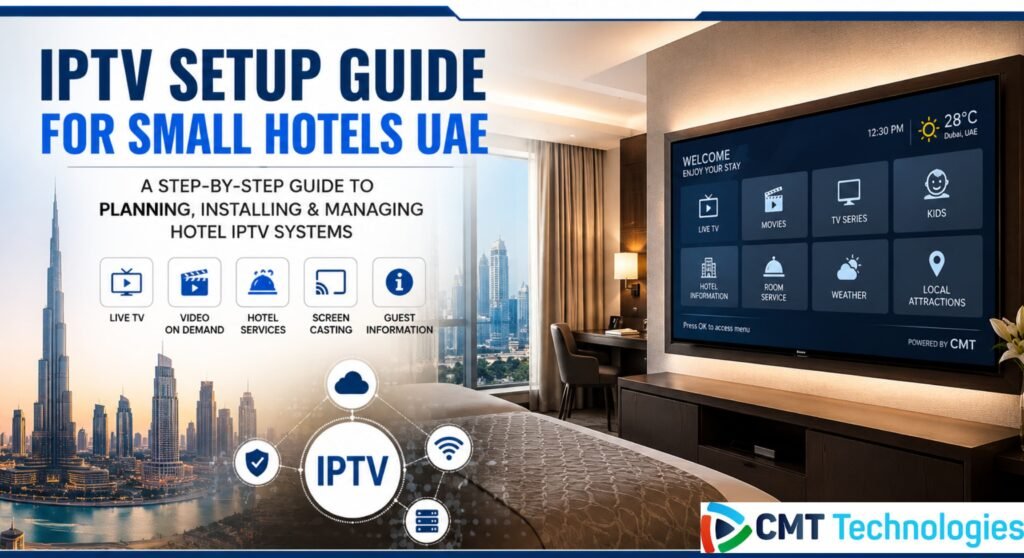
An IPTV, or Internet Protocol Television, system delivers live TV, video on demand, and interactive hotel services through a property’s internal IP network. Rather than distributing signal through coaxial cable, IPTV streams digital content straight to guest room televisions over standard networking equipment.
A modern hotel IPTV platform typically includes:
- Live television channels
- Video on demand libraries
- Personalized welcome messages
- Digital hotel information and directories
- Restaurant menus and room service ordering
- Weather and flight information
- Local attractions and concierge content
- Screen casting from guest devices
For properties in Dubai, Abu Dhabi, Sharjah, and other UAE cities, IPTV also builds a premium guest experience without the cost and complexity of a full legacy TV overhaul.
Why Small Hotels in the UAE Should Choose IPTV
Small hotels usually work with tighter budgets than five star chains, so every technology investment has to earn its place. It needs to lift guest satisfaction while trimming, not adding to, operational overhead. IPTV does both.

Better guest experience. Guests browse channels, stream on demand content, and pull up hotel information through one intuitive interface instead of hunting for a paper directory or calling the front desk.
Centralized content management. Managers update promotions, room information, and announcements across every television in the property from a single dashboard, often in minutes rather than hours.
Higher revenue opportunities. Hotels can promote spa services, airport transfers, restaurant offers, local tours, event packages, and room upgrades directly on the in room screen, turning idle television time into a sales channel.
Reduced maintenance. Centralized, digital content management cuts down on the manual, room by room configuration that legacy systems demand, which matters even more when your engineering team is small.
Essential Components of a Hotel IPTV System
Before installation begins, it helps to understand what actually makes up an IPTV deployment.
| Component | Purpose |
|---|---|
| IPTV Headend | Receives and processes incoming TV channels |
| IPTV Middleware | Controls users, content, and the guest interface |
| Content Management System | Updates hotel information and media |
| Network Switches | Deliver IPTV traffic across the property |
| Smart TVs or Set Top Boxes | Display IPTV services in guest rooms |
| Video on Demand Server | Stores movies and digital content |
| Streaming Server | Distributes IPTV streams across the network |
Each component plays a distinct role, and skipping proper sizing on any one of them is usually where small hotel deployments run into trouble later.
Network Requirements
A reliable network is the real foundation of any IPTV deployment, more so than the television hardware itself. Before installation starts, verify the following:

- Gigabit network switches throughout the property
- Managed switches with VLAN support
- Quality Ethernet cabling, tested end to end
- Stable, sufficiently provisioned internet connectivity
- A dedicated IPTV VLAN, separate from guest WiFi and back office traffic
- Proper bandwidth allocation per room
Hotels should also prioritize Quality of Service, or QoS, settings on the network to prevent buffering during peak check in hours, when dozens of guests might be streaming simultaneously.
Step by Step IPTV Setup Guide
Step 1: Assess Your Hotel’s Requirements
Start by identifying the number of guest rooms and televisions, the state of your existing network infrastructure, current internet capacity, available server room space, and any future expansion plans. Planning properly at this stage reduces costly rework later, which is the single most common regret we hear from hotel owners who rushed installation.
Step 2: Select the Right IPTV Platform
Choose a platform built specifically for hospitality, not a consumer grade product repurposed for a hotel. Look for a multi language interface, hotel branding options, PMS integration, casting support, interactive menus, remote management, and an analytics dashboard. Consumer IPTV systems rarely scale to hospitality’s authentication and content licensing needs.
Step 3: Upgrade the Network
If your existing network cannot handle video traffic efficiently, upgrade it before deployment rather than after. Recommended improvements include a gigabit backbone, fiber uplinks, enterprise grade switches, VLAN segmentation, and redundant network paths. Reliable infrastructure here minimizes the service interruptions that generate the most guest complaints.
Step 4: Install the IPTV Headend
The headend receives television channels from satellite, cable, or terrestrial sources and converts those signals into IP streams for distribution across the hotel network. Professional configuration at this stage is what keeps channel delivery stable during peak load, and it is not a step worth cutting corners on.
Step 5: Configure Middleware
Middleware is the control center of the entire IPTV system. It manages guest authentication, channel lists, the user interface, billing integration, content scheduling, and language selection. This is also the layer that determines how intuitive, or how frustrating, the guest experience actually feels.
Step 6: Connect Smart TVs
Many modern hospitality televisions support IPTV natively. Older televisions may need IPTV set top boxes instead. Every television should be tested individually before the system opens to guests, since a single misconfigured room can generate a disproportionate number of complaints.
Step 7: Test Every Guest Room
Before launch, verify channel availability, video quality, audio synchronization, VOD playback, hotel information pages, internet connectivity, screen casting, and interface responsiveness in every single room. Testing thoroughly now prevents a wave of negative guest experiences right after opening.
Features Small Hotels Should Prioritize

Not every IPTV feature is necessary for a smaller property, and trying to launch with everything at once usually slows deployment down. Focus on the features that deliver the greatest guest value first: live TV, video on demand, a welcome screen, hotel promotions, weather information, a digital guest directory, room service menus, housekeeping requests, guest messaging, and device casting. Additional features can be layered in later as the property grows.
Common IPTV Installation Mistakes
Many hotel owners purchase IPTV equipment before planning their network, and that decision tends to lead to expensive upgrades down the line. Avoid these common mistakes: choosing low quality network hardware, ignoring bandwidth requirements, buying consumer grade IPTV equipment, skipping staff training, not testing every room individually, poor cable management, weak cybersecurity practices, and having no backup strategy. A properly planned installation, even a modest one, saves both time and money compared to a rushed rollout that needs fixing later.
Estimated IPTV Costs for Small Hotels
Pricing varies based on room count, hardware selection, software licensing, and integration requirements. Typical cost factors include IPTV servers, middleware licensing, smart TVs, set top boxes, installation labor, network upgrades, content licensing, and ongoing maintenance contracts.
Rather than comparing prices in isolation, request a detailed proposal from an experienced IPTV system integrator. Long term reliability and local technical support in the UAE usually deliver far better value than the lowest initial quote, particularly once you factor in downtime costs from a system that was not sized correctly the first time.
Best Practices for Hotels in the UAE
Hospitality businesses in the UAE should work with providers who understand local regulations and multilingual guest expectations. It is worth checking your provider’s network compliance against guidance from the UAE Telecommunications and Digital Government Regulatory Authority before finalizing any deployment.
Consider these best practices: use enterprise grade networking equipment, keep software and firmware updated, monitor network performance regularly, back up configuration files, train hotel staff before launch, schedule preventive maintenance, review guest feedback continuously, and choose a scalable platform that supports future room expansion.
CMT Technologies has applied these same principles across hospitality, healthcare, and government deployments throughout the UAE and Saudi Arabia, working alongside partners such as Uniguest, EQX TV, MVI Systems, and VIDI, with network infrastructure built on Cisco and AWS.
Frequently Asked Questions
How long does IPTV installation take for a small hotel?
Can IPTV work with our existing hotel TVs?
Does IPTV require internet access to function?
Can IPTV integrate with our hotel management system?
Connect with CMT Technologies
Contact us via our website to schedule your personalized demonstration.
Contact on Whatsapp
+971-504441830
Say Hello
sales@cmt-technologies.com
Social Just You Connected Us!